Trainable Evolutionary Algorithms: A Reinforcement Learning Perspective on Algorithm Configuration

Abstract
Contributions
- Studies algorithm configuration for trainable evolutionary algorithms and proposes an RL-based configuration framework for NeuroEA.
- Employs a Soft Actor-Critic agent to generate NeuroEA parameter configurations under both static and dynamic paradigms.
- Provides insights into the advantages and limitations of static vs. dynamic configuration for trainable EAs.
Method
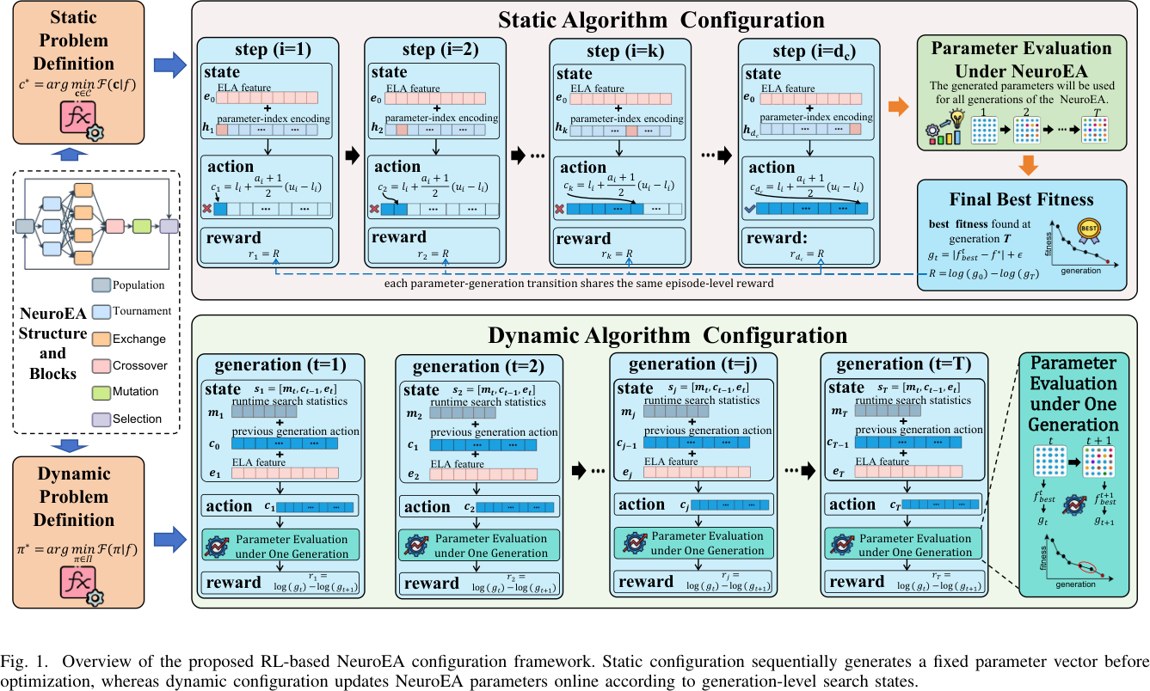
A Soft Actor-Critic (SAC) agent generates parameter configurations for NeuroEA — a neural-network-like modular evolutionary algorithm — while NeuroEA performs the optimization; in the static paradigm parameters are fixed before optimization starts, whereas the dynamic paradigm continuously updates them according to runtime search states.
Experimental Results
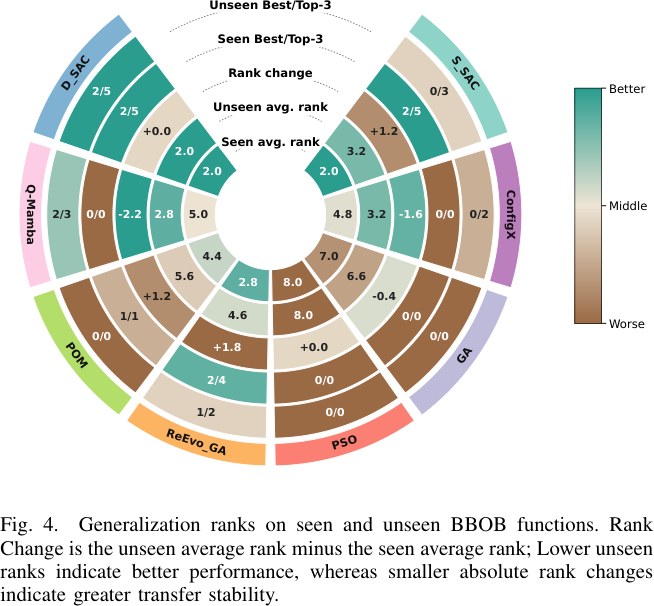
Compared algorithms: GA, PSO, GA+ARSBX, APSO, RefPo_GA, POM, RLDE-ATL, Q-Mumba, ConfigX, and the restricted static S-SAC configurator.
Datasets: BBOB (F1–F10) and SOP benchmark problems (D = 10).
Metrics: Mean fitness (standard deviation) over independent runs with significance signs; average rank on unseen functions.
Overall results: D-SAC attains the best mean results on most problems (4/42 significant wins with none lost) and the best unseen average rank, showing that dynamic RL-based configuration transfers well to unseen landscapes.
BibTeX
@inproceedings{li2026trainable, title = {Trainable Evolutionary Algorithms: A Reinforcement Learning Perspective on Algorithm Configuration}, author = {Li, Wenbiao and Yang*, Shangshang and Tian, Ye and Sheng, Zimo}, booktitle = {The 8th International Conference on Data-driven Optimization of Complex Systems (DOCS 2026)}, year = {2026}, }