PEOAT: Personalization-Guided Evolutionary Question Assembly for One-Shot Adaptive Testing
Proceedings of the Fortieth AAAI Conference on Artificial Intelligence (AAAI), 2026
AAAI 2026
Abstract
With the rapid advancement of intelligent education, Computerized Adaptive Testing (CAT) has attracted increasing attention by integrating educational psychology with deep learning technologies. Unlike traditional paper-and-pencil testing, CAT aims to efficiently and accurately assess examinee abilities by adaptively selecting the most suitable items during the assessment process. However, its real-time and sequential nature presents limitations in practical scenarios, particularly in large-scale assessments where interaction costs are high, or in sensitive domains such as psychological evaluations where minimizing noise and interference is essential. These challenges constrain the applicability of conventional CAT methods in time-sensitive or resourceconstrained environments. To this end, we first introduce a novel task called one-shot adaptive testing (OAT), which aims to select a fixed set of optimal items for each test-taker in a one-time selection. Meanwhile, we propose PEOAT, a Personalization-guided Evolutionary question assembly framework for One-shot Adaptive Testing from the perspective of combinatorial optimization. Specifically, we began by designing a personalization-aware initialization strategy that integrates differences between examinee ability and exercise difficulty, using multi-strategy sampling to construct a diverse and informative initial population. Building on this, we proposed a cognitive-enhanced evolutionary framework incorporating schema-preserving crossover and cognitively guided mutation to enable efficient exploration through informative signals. To maintain diversity without compromising fitness, we further introduced a diversity-aware environmental selection mechanism. The effectiveness of PEOAT is validated through extensive experiments on two datasets, complemented by case studies that uncovered valuable insights.
Contributions
- Introduces a novel task, One-shot Adaptive Testing (OAT), which selects a fixed subset of items in one shot instead of sequentially choosing items, suited for large-scale or noise-sensitive assessments.
- Proposes PEOAT, a personalization-guided evolutionary question assembly method to solve the OAT task.
- Demonstrates that a well-assembled fixed item set can approach the accuracy of fully adaptive testing at much lower interaction cost.
Method
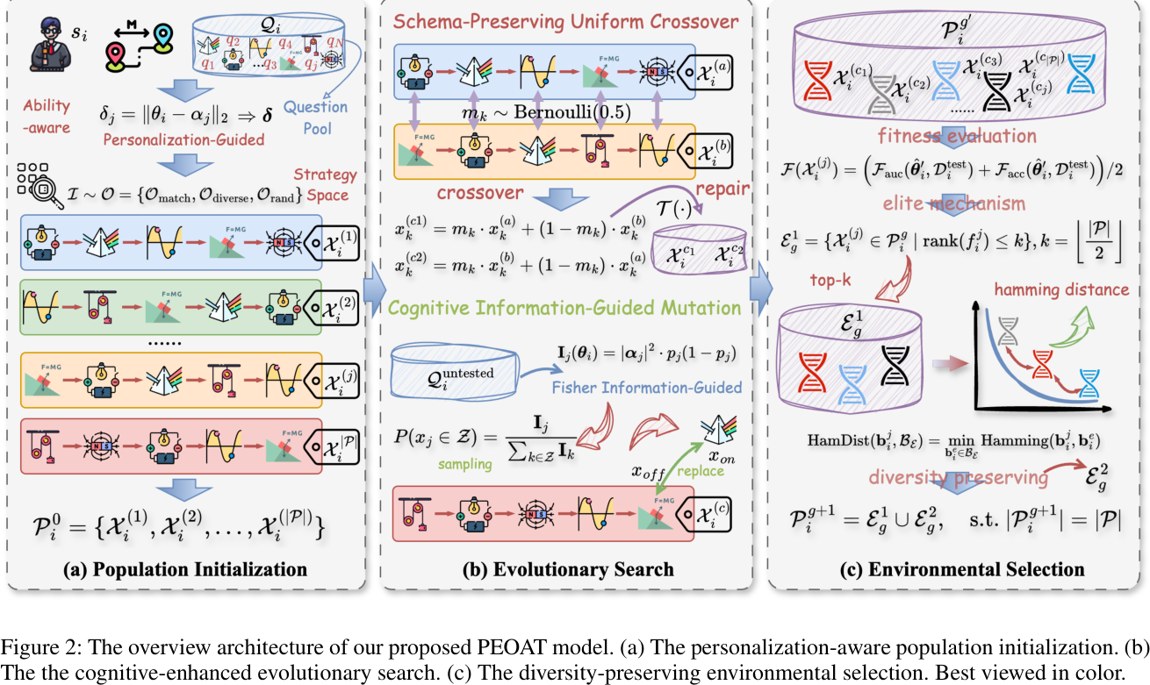
PEOAT formulates the selection of the fixed item set as an optimization problem and employs an evolutionary algorithm whose search is guided by personalization signals derived from examinee ability distributions, assembling a item set that covers diverse ability levels and maximizes overall assessment precision.
Experimental Results
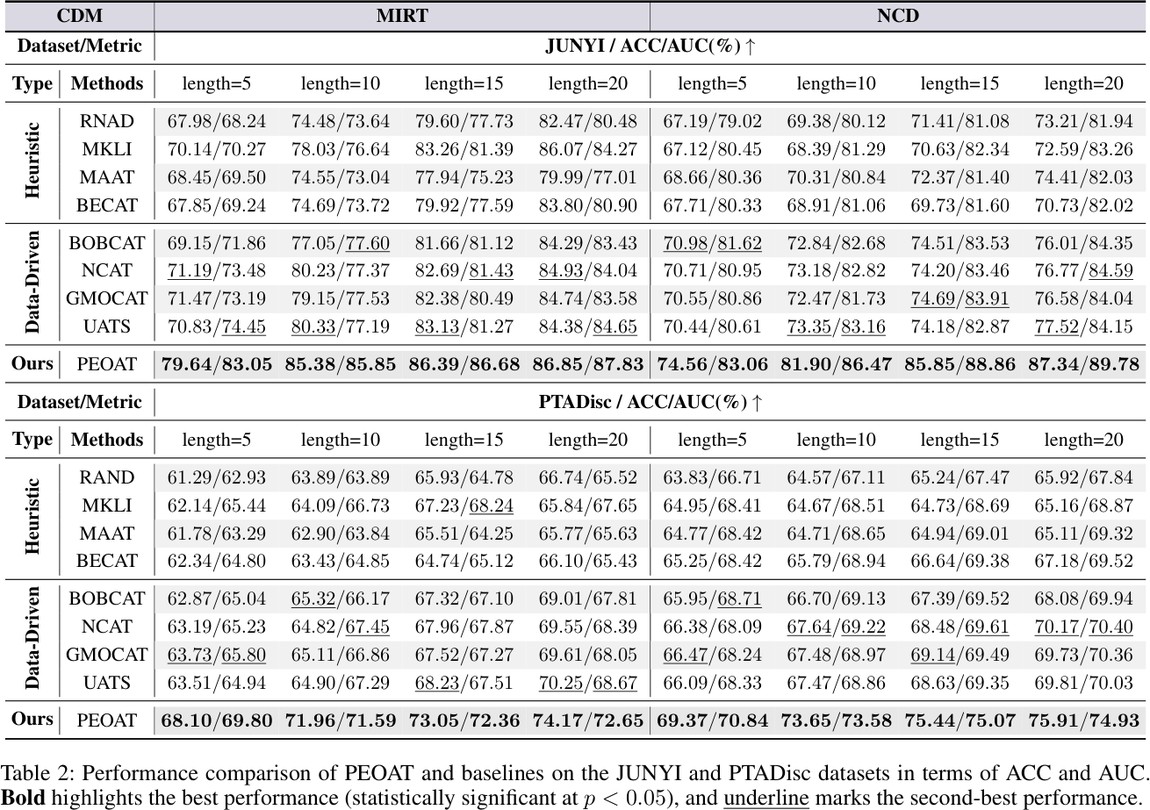
Compared algorithms: Heuristic selectors (RAND, MKLI, MAAT, BECAT) and data-driven selectors (BOCAT, NCAT, GMOCAT, UATS).
Datasets: JUNYI and PTADisc.
Metrics: ACC and AUC at quiz lengths from 5 to 20.
Overall results: PEOAT delivers the best performance in almost all settings, with average improvements of 7.74%/5.82% in AUC on JUNYI and 6.97%/5.62% in ACC on PTADisc over the second-best method.
BibTeX
@inproceedings{yu2026peoat, title = {PEOAT: Personalization-Guided Evolutionary Question Assembly for One-Shot Adaptive Testing}, author = {Yu, Xiaoshan and Huang, Ziwei and Yang*, Shangshang and Wang, Ziwen and Ma, Haiping and Zhang, Xingyi}, booktitle = {Proceedings of the Fortieth AAAI Conference on Artificial Intelligence}, year = {2026}, }