Cognitive Diagnosis-Based Personalized Exercise Group Assembly via a Multi-Objective Evolutionary Algorithm
Shangshang Yang, Haoyu Wei, Haiping Ma*, Ye Tian, Xingyi Zhang, Yunbo Cao, Yaochu Jin
IEEE Transactions on Emerging Topics in Computational Intelligence, 2023
TETCI 2023
Abstract
Exercise group recommendation plays an important role in many intelligent education tasks. However, existing approaches make recommendations based on the intrinsic features of exercises without considering students' learning abilities, or make selections from several pre-built exercise groups at the expense of flexibility. Furthermore, although many cognitive diagnosis approaches have successfully revealed students' abilities, how to leverage the diagnosis results for exercise group recommendation is hardly explored. To flexibly recommend suitable exercise groups to students, this paper proposes to assemble personalized exercises as a group based on students' abilities, called Personalized Exercise Group Assembly (PEGA). To solve the PEGA task, we first formulate it as a constrained multi-objective problem (CMOP), where three objectives are designed for enabling the assembled exercises to enhance students' abilities on both weak and new knowledge concepts. Then, we devise an extended neural cognitive diagnosis model to learn student's ability/proficiency on all knowledge concepts to compute the weakness consolidation objective. Besides, we propose a dual-encoding and dual-population based co-evolutionary algorithm to tackle the CMOP, where the main population with binary encoding is used to search which exercises are selected, and the auxiliary population with integer encoding is responsible for accelerating the convergence of the main population via guiding offspring generation of the main population. Experiments on three popular datasets demonstrate the effectiveness of exercises assembled by the proposed algorithm compared to state-of-the-art exercise group recommendation approaches, where our assembled exercises can enhance students' proficiency on both poorly mastered and new knowledge concepts.
Contributions
- Formulates personalized exercise group assembly (PEGA) as a constrained multi-objective optimization problem driven by cognitive diagnosis results.
- Designs three objectives so that the assembled group matches the student’s ability, covers target concepts, and controls redundancy.
- Solves the problem with a constrained multi-objective evolutionary algorithm with repair-based constraint handling.
Method
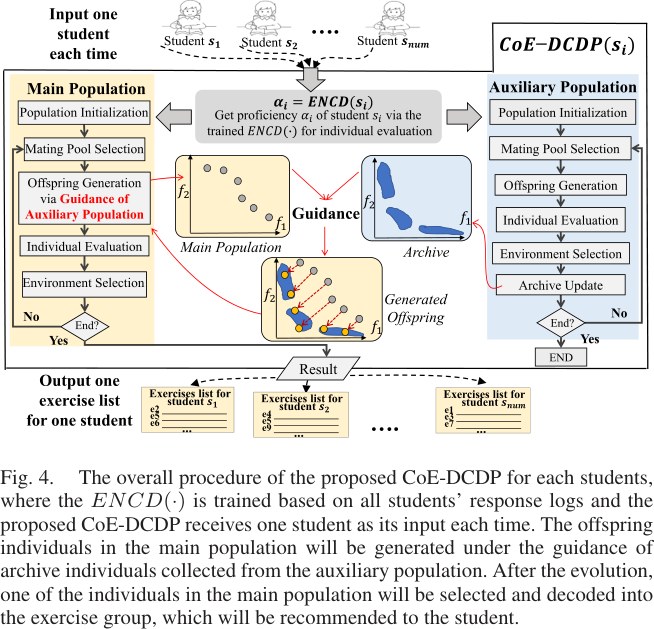
Based on the diagnosed ability of each student, PEGA encodes candidate exercise groups as individuals and evolves them under constraints on group size and concept coverage; the evolutionary search returns a set of non-dominated exercise groups adapted to the student’s proficiency.
Experimental Results
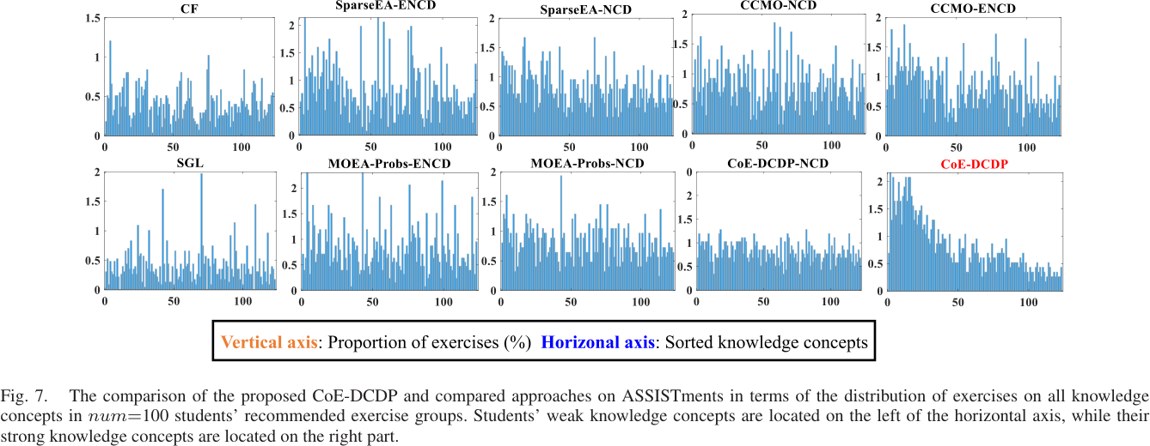
Compared algorithms: Collaborative filtering (CF, SGL) and six MOEA-based approaches (MOEA-Probs/SparseEA/CCMO combined with NCD or ENCD).
Datasets: ASSISTments, JunYi, and SLP (100 students each).
Metrics: Pearson/Spearman/Kendall correlations between true ability and exercise difficulty (lower is better).
Overall results: CoE-DCDP attains the lowest correlations on nearly all dataset–metric pairs (e.g., −0.5589 Pearson on ASSISTments), meaning its assembled exercise groups match students’ actual ability far better.
BibTeX
@article{yang2023assembly, title = {Cognitive Diagnosis-Based Personalized Exercise Group Assembly via a Multi-Objective Evolutionary Algorithm}, author = {Yang, Shangshang and Wei, Haoyu and Ma*, Haiping and Tian, Ye and Zhang, Xingyi and Cao, Yunbo and Jin, Yaochu}, journal = {IEEE Transactions on Emerging Topics in Computational Intelligence}, volume = {7}, number = {3}, pages = {829--844}, year = {2023}, }