Accelerating Evolutionary Neural Architecture Search via Multi-Fidelity Evaluation
IEEE Transactions on Cognitive and Developmental Systems, 2022
TCDS 2022
🏆 Best Poster Paper

Abstract
Evolutionary neural architecture search (ENAS) has recently received increasing attention by effectively find- ing high-quality neural architectures, which however consumes high computational cost by training the architecture encoded by each individual for complete epochs in individual evalua- tion. Numerous ENAS approaches have been developed to reduce the evaluation cost, but it is often difficult for most of these approaches to achieve high evaluation accuracy. To address this issue, in this article, we propose an accelerated ENAS via multifidelity evaluation termed MFENAS, where the individual evaluation cost is significantly reduced by training the archi- tecture encoded by each individual for only a small number of epochs. The balance between evaluation cost and evaluation accuracy is well maintained by suggesting a multifidelity evalua- tion, which identifies the potentially good individuals that cannot survive from previous generations by integrating multiple eval- uations under different numbers of training epochs. Besides, a population initialization strategy is devised to produce diverse neural architectures varying from ResNet-like architectures to Inception-like ones. As shown by experiments, the proposed MFENAS takes only 0.6 GPU days to find the best archi- tecture holding a 2.39% test error rate, which is superior to most state-of-the-art neural architecture search approaches. And the architectures transferred to CIFAR-100 and ImageNet also exhibit competitive performance.
Contributions
- Proposes MFENAS, which accelerates evolutionary NAS by training each architecture for only a small number of epochs.
- Designs a multi-fidelity evaluation strategy that identifies potentially good individuals from low-fidelity evaluations.
- Well maintains the balance between evaluation cost and evaluation accuracy.
Method
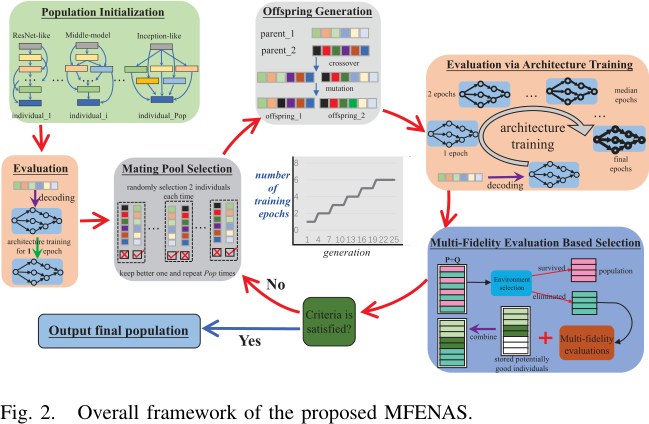
Instead of fully training every individual, MFENAS evaluates architectures at low fidelity (few epochs) and uses a selection mechanism that promotes individuals whose early-training performance indicates high final quality; only the most promising architectures are trained at higher fidelity.
Experimental Results
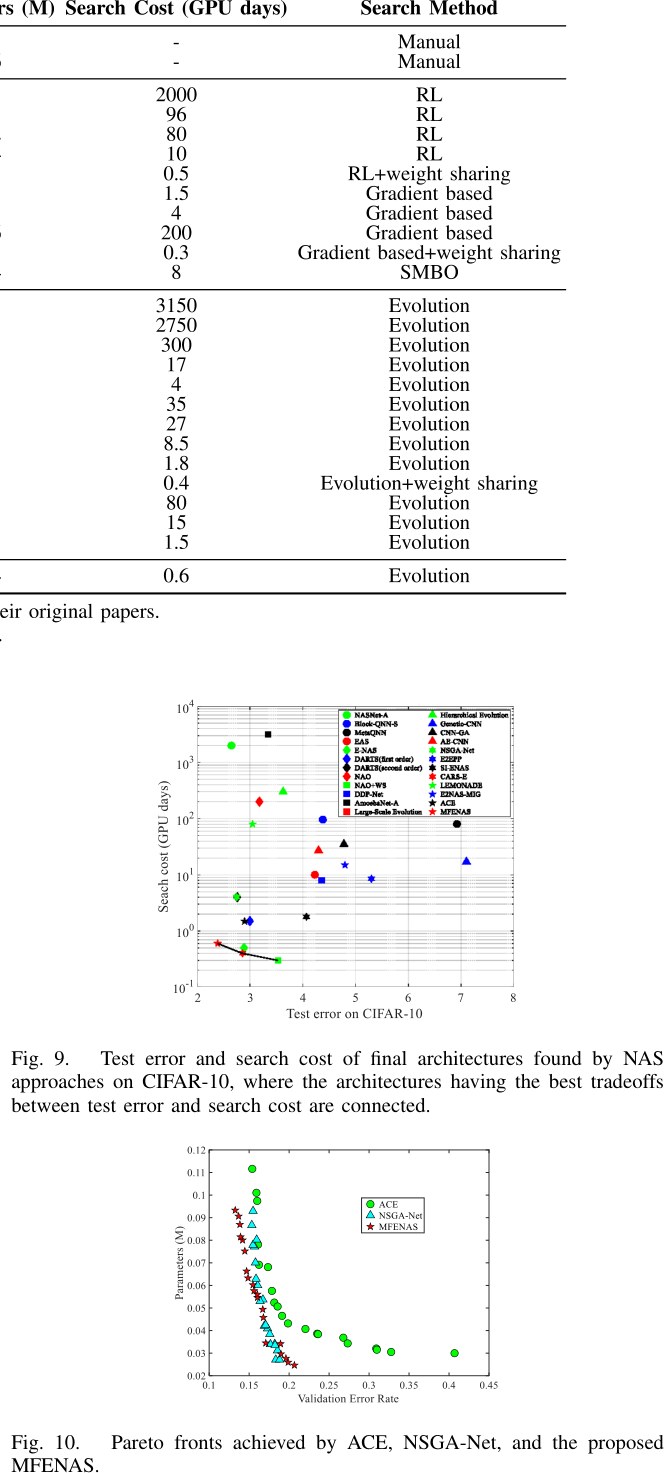
Compared algorithms: 22 peer competitors: manual designs, RL-based (NASNet-A, NASBOT), gradient-based (DARTS, SNAS), and evolutionary (AmoebaNet-A, Genetic-CNN, AE-CNN) approaches.
Datasets: CIFAR-10.
Metrics: Test error, number of parameters, and search cost (GPU-days).
Overall results: MFENAS attains the lowest test error (2.39%) with only 0.6 GPU-days of search cost.
BibTeX
@article{yang2022accelerating, title = {Accelerating Evolutionary Neural Architecture Search via Multi-Fidelity Evaluation}, author = {Yang, Shangshang and Tian, Ye and Xiang*, Xiaoshu and Peng, Shicheng and Zhang*, Xingyi}, journal = {IEEE Transactions on Cognitive and Developmental Systems}, volume = {14}, number = {4}, pages = {1778--1792}, year = {2022}, }