Enhancing Learning Path Recommendation via Knowledge Topology-Aware Sequence Optimization
ACM SIGIR Conference on Research and Development in Information Retrieval, 2025
SIGIR 2025
Abstract
Learning path recommendation (LPR) aims to provide individualized and effective learning item routes by modeling learners' learning histories and goals, which has been widely considered a essential task in the field of personalized education. Indeed, considerable research efforts have been dedicated to this direction in recent years, focusing on step-based and sequence-based modeling approaches. However, most of existing studies overlook the complementarity between explicit and implicit relationships among knowledge concepts, while failing to harmonize static knowledge structures with dynamic path generation. To this end, in this paper, we propose LIGHT, a knowLedge topology-aware sequence optImization model for enhancing learninG patH recommendaTion. Specifically, we first construct a composite concept graph that incorporates explicit prerequisite relationships and implicit collaborative relationships, achieved by mining interaction statistics and collaborative signals from learners' learning processes. Next, we design a complementary contrastive fusion module to fully capture the interplay between the two relational views of concepts through graph structure learning and contrastive constraints, which enhances the effectiveness of the learned representations. Following this, we introduce a knowledge topology-aware modeling module that integrates structural semantics clustering with candidate path sampling. Finally, we develop a bidirectional sensing path optimization network to deeply model and optimize the sampled paths from a sequential perspective, thereby enhancing modeling efficiency while preserving structural semantics. Extensive experiments on three real-world educational datasets clearly demonstrate the effectiveness of the proposed LIGHT model in the LPR task.
Contributions
- Proposes LIGHT, a knowledge topology-aware sequence optimization model for learning path recommendation.
- Constructs a composite concept graph that fuses explicit prerequisite relations with implicit collaborative signals.
- Harmonizes the static knowledge structure with dynamic path generation during recommendation.
Method
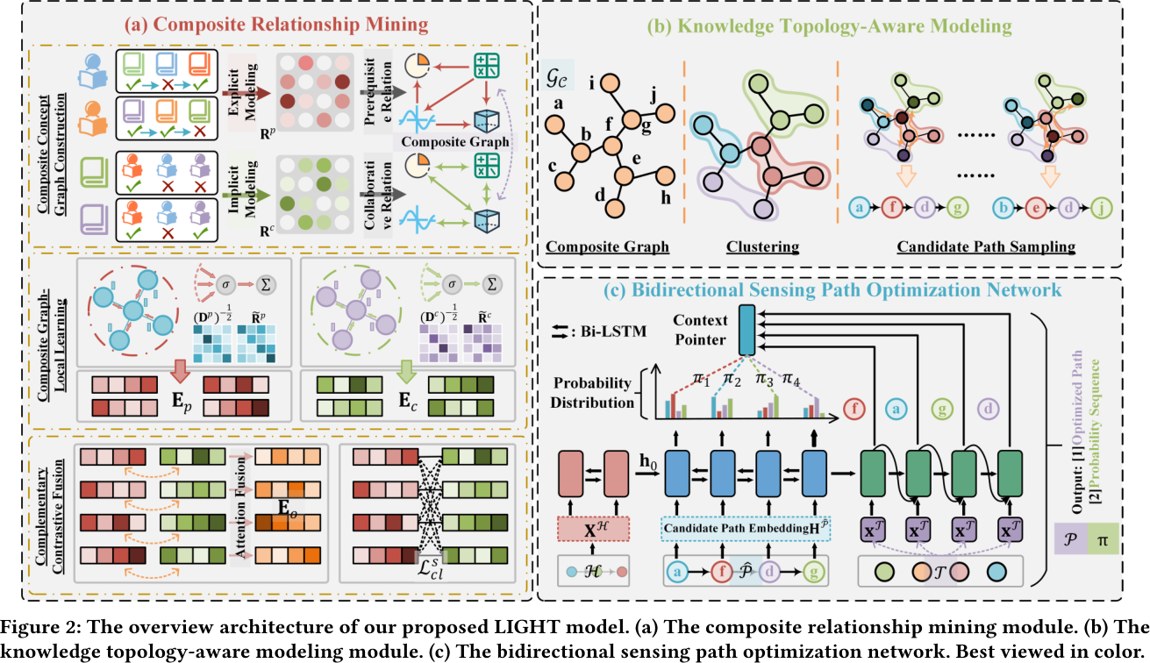
LIGHT first builds a composite concept graph combining prerequisite edges mined from curricula and collaborative edges learned from learner behaviors, then optimizes generated learning sequences against this topology so that recommended paths respect both conceptual dependencies and observed learning regularities.
Experimental Results
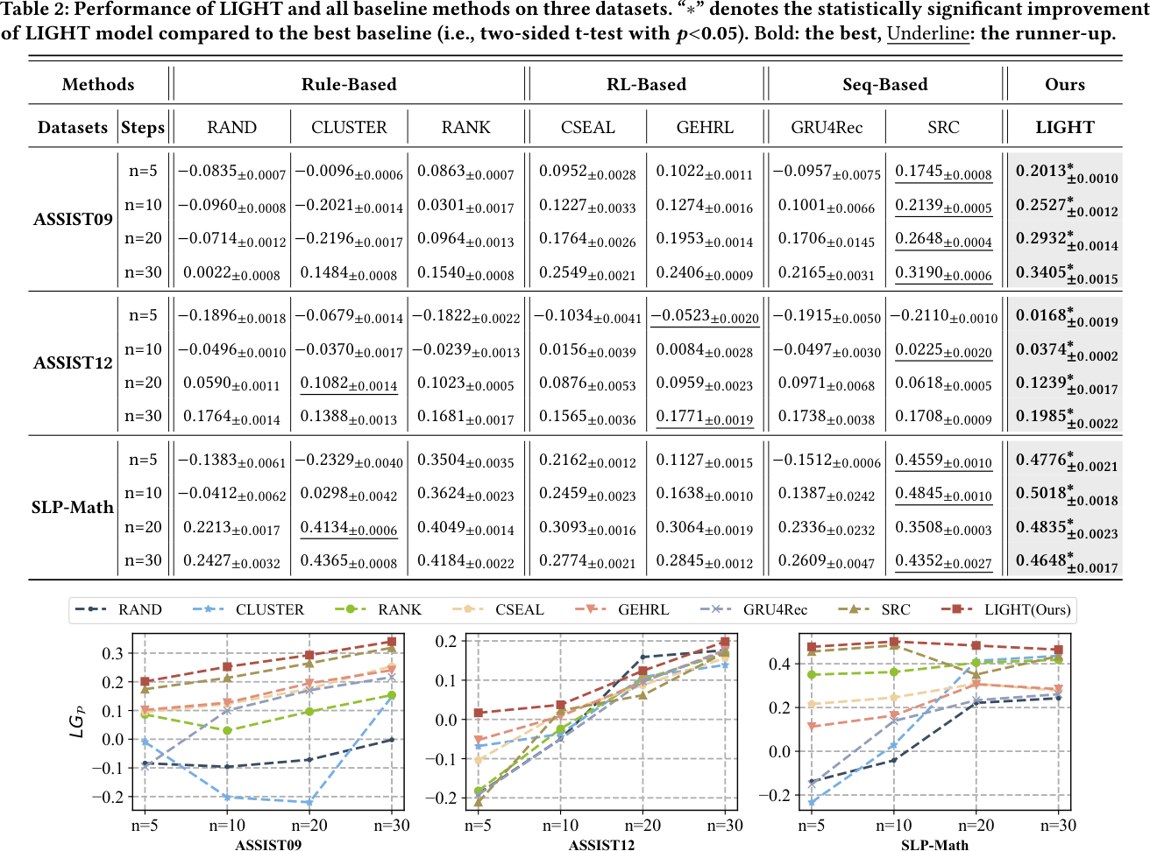
Compared algorithms: Rule-based (RAND, CLUSTER, RANK), RL-based (CSEAL, GEHRL), and sequence-based (GRU4Rec, SRC) methods.
Datasets: ASSIST09, ASSIST12, and SLP-Math.
Metrics: Learning-path gain (LG) at path lengths from 5 to 30.
Overall results: LIGHT obtains the best LG scores in every dataset and length setting, indicating that topology-aware sequence optimization yields genuinely better learning paths.
BibTeX
@inproceedings{yu2025enhancing, title = {Enhancing Learning Path Recommendation via Knowledge Topology-Aware Sequence Optimization}, author = {Yu, Xiaoshan and Yang*, Shangshang and Wang, Ziwen and Song, Shuang and Ma, Haiping and Cao, Zhen and Zhang, Xingyi}, booktitle = {ACM SIGIR Conference on Research and Development in Information Retrieval}, pages = {306--315}, year = {2025}, doi = {10.1145/3726302.3730022} }