Hybrid Architecture-based Evolutionary Robust Neural Architecture Search
Shangshang Yang, Xiangkun Sun, Ke Xu, Yuanchao Liu, Ye Tian*, Xingyi Zhang*
IEEE Transactions on Emerging Topics in Computational Intelligence, 2024
TETCI 2024
Abstract
The robustness of neural networks in image classification is important to resist adversarial attacks. Although many researchers proposed to enhance the network robustness by inventing network training paradigms or designing network architectures, existing approaches are mainly based on a single type of networks, e.g., convolution neural networks (CNNs) or vision Transformer (ViT). Considering a recently revealed fact that CNNs and ViT can effectively defend against adversarial attacks transferred from each other, this paper aims to enhance network robustness by designing robust hybrid architecture networks containing different types of networks. To this end, we propose a hybrid architecture-based evolutionary neural architecture search approach for robust architecture design, termed HA-ENAS. Specifically, to combine or aggregate different types of networks in the same network framework, a multi-stage block-wise hybrid architecture network is first devised as the supernet, where three types of blocks (called convolution blocks, Transformer blocks, multi-layer perception blocks) are further designed as each block's candidate, and thus a hybrid architecture-based search space is established for HA-ENAS; then, the robust hybrid architecture search is formulated as an optimization problem maximizing both clean and adversarial accuracy of architectures, and an efficient multi-objective evolutionary algorithm is employed to solve the problem, where a supernet-based retraining evaluation and a surrogate model are used to mitigate coupled weight influence and reduce the whole search cost. Experimental results show that the hybrid architectures found by the proposed HA-ENAS outperform state-of-the-art single-type architectures in terms of clean accuracy and adversarial accuracy under a variety of common attacks.
Contributions
- Proposes HA-ENAS, an evolutionary NAS approach that designs robust hybrid architectures combining CNNs and Vision Transformers.
- Exploits the fact that CNNs and ViTs effectively defend against adversarial attacks transferred from each other.
- Designs hybrid encoding and crossover/mutation operators that handle heterogeneous network blocks.
Method
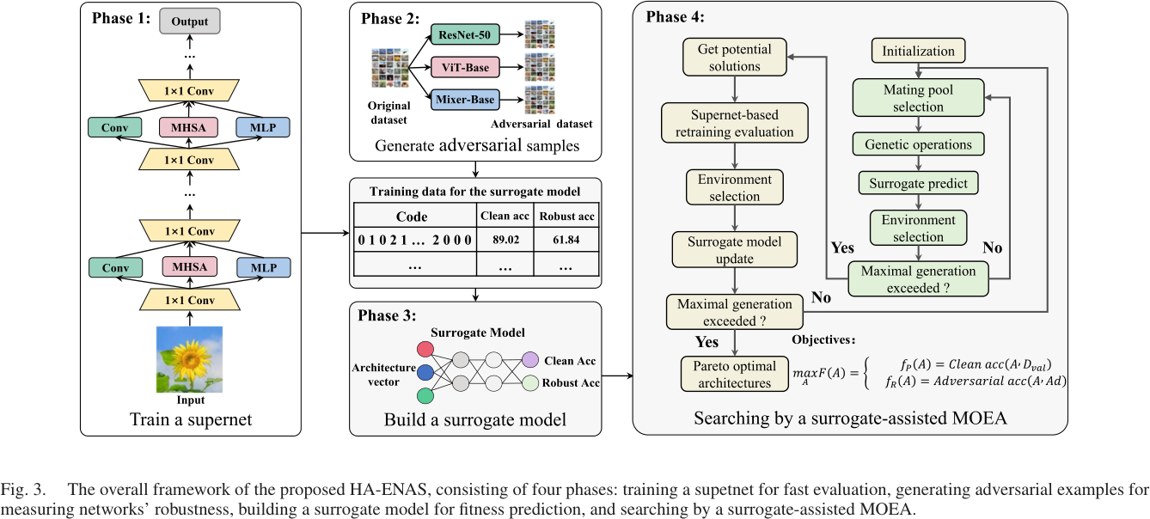
HA-ENAS defines a search space in which a single network may contain both convolutional and self-attention blocks; a multi-objective evolutionary algorithm searches for architectures balancing clean accuracy and robustness under adversarial attacks.
Experimental Results
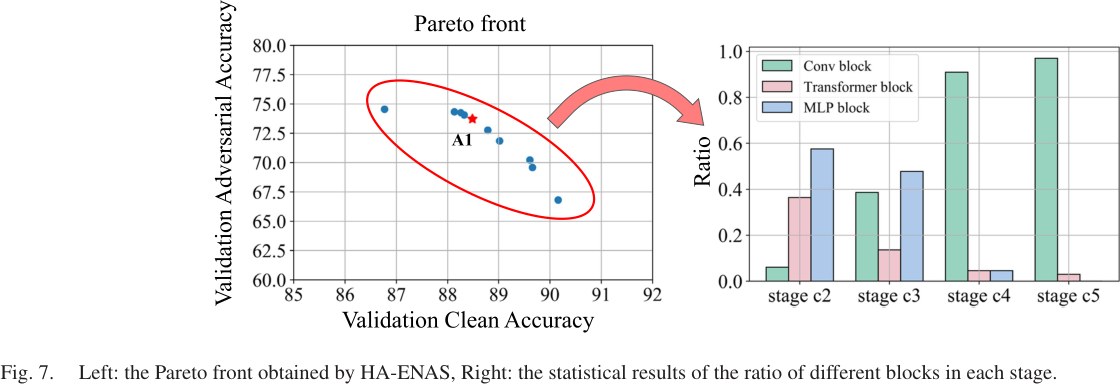
Compared algorithms: Handcrafted CNN/ViT/hybrid backbones (VGG, ResNet, RobNet, AdvRush, CRoZe, ViT-S/B-16, ResMLP, Mixer, BoTNet-50).
Datasets: CIFAR-100.
Metrics: Clean accuracy and adversarial accuracy under FGSM, MI-FGSM, and PGD transfer attacks (averaged over 30 runs).
Overall results: The evolved HA-Net-A1-C100 clearly surpasses all compared networks under every attack (e.g., 37.88% FGSM accuracy on ViT-B/16 surrogates and the best PGD robustness), achieving the most favorable robustness-accuracy trade-off.
BibTeX
@article{yang2024hybrid, title = {Hybrid Architecture-based Evolutionary Robust Neural Architecture Search}, author = {Yang, Shangshang and Sun, Xiangkun and Xu, Ke and Liu, Yuanchao and Tian*, Ye and Zhang*, Xingyi}, journal = {IEEE Transactions on Emerging Topics in Computational Intelligence}, year = {2024}, }