Reconciling Efficiency and Effectiveness of Exercise Retrieval: An Uncertainty Reduction Hashing Approach for Computerized Adaptive Testing
ACM SIGIR Conference on Research and Development in Information Retrieval, 2025
SIGIR 2025
Abstract
With the rapid development of intelligent education, Computerized Adaptive Testing(CAT) has garnered significant attention for its ability to tailor exercises to individual examinees. The adaptability of CAT is primarily achieved through the alternating optimization of two core components: the cognitive diagnosis model and the exercise selection module. However, existing CAT approaches, de- spite their remarkable achievements, often come at the expense of high time costs. Statistical-based approaches incur increased time overhead due to complex computations, while data-driven approaches further exacerbate time inefficiency because of the iter- ative processes in reinforcement learning, making it challenging to balance evaluation effectiveness and time efficiency. To this end, in this paper, we propose HashCAT, an efficient CAT approach based on learning to hash, aiming to balance efficiency and evalu- ation effectiveness. Our approach comprises two stages: the hash representation generation and the exercise selection. In the first ∗Corresponding author Permission to make digital or hard copies of all or part of this work for personal or classroom use is granted without fee provided that copies are not made or distributed for profit or commercial advantage and that copies bear this notice and the full citation on the first page. Copyrights for components of this work owned by others than the author(s) must be honored. Abstracting with credit is permitted. To copy otherwise, or republish, to post on servers or to redistribute to lists, requires prior specific permission and/or a fee. Request permissions from permissions@acm.org. SIGIR ’25, Padua, Italy © 2025 Copyright held by the owner/author(s). Publication rights licensed to ACM. ACM ISBN 979-8-4007-1592-1/2025/07 https://doi.org/10.1145/3726302.3730072 stage, we design an information alignment module and a novel cognitive diagnosis function to model the interaction between ex- aminees and exercises, generating hash representations with clear physical significance. In the second stage, we propose an uncer- tainty reduction-based algorithm that utilize information entropy to quantify the uncertainty in student ability estimation and selects exercises that most effectively reduce this uncertainty. Experimen- tal results on four real-world datasets demonstrate that the pro- posed method significantly improves question selection efficiency while maintaining competitive evaluation performance. The code exists anonymously in https://github.com/sherklock/Intelligent- Education/tree/main/HashCAT-main.
Contributions
- Proposes HashCAT, an efficient CAT approach based on learning to hash, reconciling evaluation effectiveness with time efficiency.
- Encodes exercises and examinees into compact hash codes so that exercise selection reduces to fast hashing-based retrieval.
- Removes the heavy iterative computation of statistical and reinforcement-learning-based selection modules.
Method
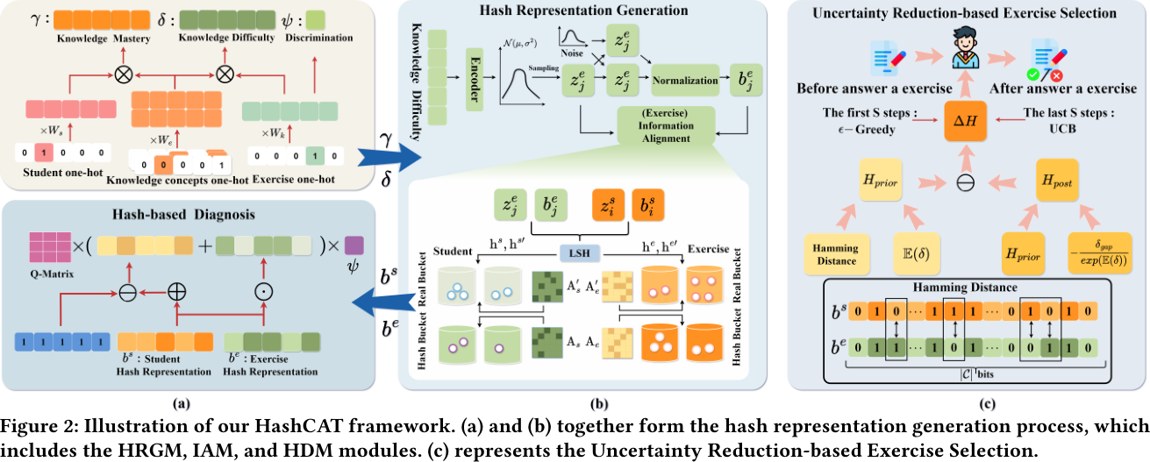
An uncertainty-reduction hashing objective trains binary representations under which the expected information gain of candidate exercises is preserved; at test time the next exercise is retrieved via Hamming-distance lookup instead of exhaustively scoring the item bank.
Experimental Results
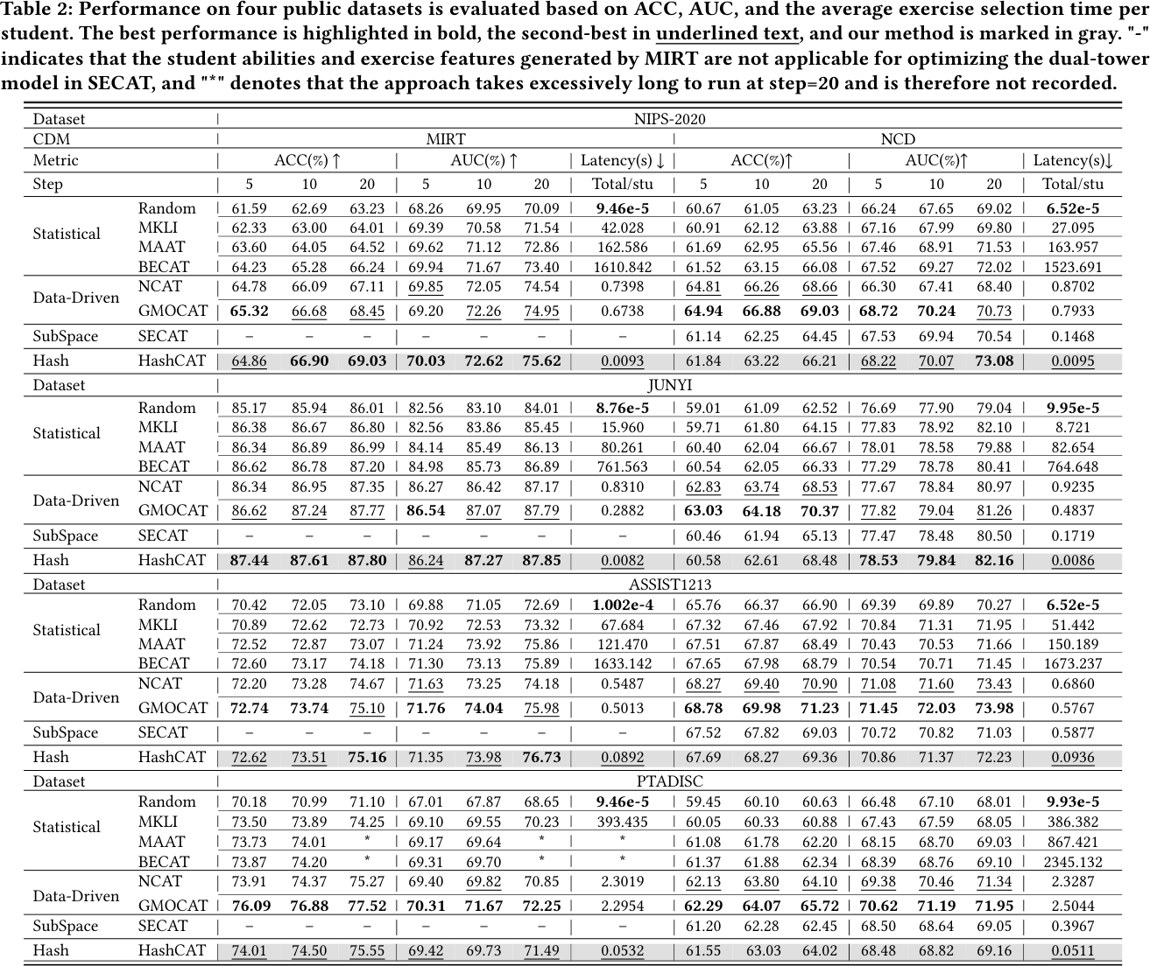
Compared algorithms: Statistical selectors (MKLI, MAAT, BECAT) and data-driven selectors (GMOCAT, BOCAT, NCAT, UATS).
Datasets: NIPS-2020, JUNYI, ASSIST2012, and PTADISC.
Metrics: ACC, AUC, and per-exercise selection latency.
Overall results: HashCAT keeps accuracy close to the best baselines while cutting selection time by an order of magnitude; several baselines are even too slow to record at step-20.
BibTeX
@inproceedings{ma2025reconciling, title = {Reconciling Efficiency and Effectiveness of Exercise Retrieval: An Uncertainty Reduction Hashing Approach for Computerized Adaptive Testing}, author = {Ma, Haiping and Zhou, Yang and Yu, Xiaoshan and Wang, Changqian and Yang*, Shangshang and Zhang, Limiao and Zhang, Xingyi}, booktitle = {ACM SIGIR Conference on Research and Development in Information Retrieval}, pages = {1044--1054}, year = {2025}, doi = {10.1145/3726302.3730072} }