FedCD: A Fairness-aware Federated Cognitive Diagnosis Framework
Abstract
Contributions
- Proposes FedCD, a fairness-aware federated cognitive diagnosis framework that jointly trains CD models across schools/clients without sharing raw student learning data.
- Devises a parameter decoupling-based personalization strategy: student embeddings and the diagnostic function stay locally personalized, while exercise embeddings are globally shared across clients and the server.
- Designs a fairness-aware aggregation mechanism that weights clients by their local prediction loss, alleviating inter-school unfairness caused by data-quality differences.
- Validates the framework on three real-world datasets under three base CD models against five FL baselines, showing superior accuracy and fairness.
Method
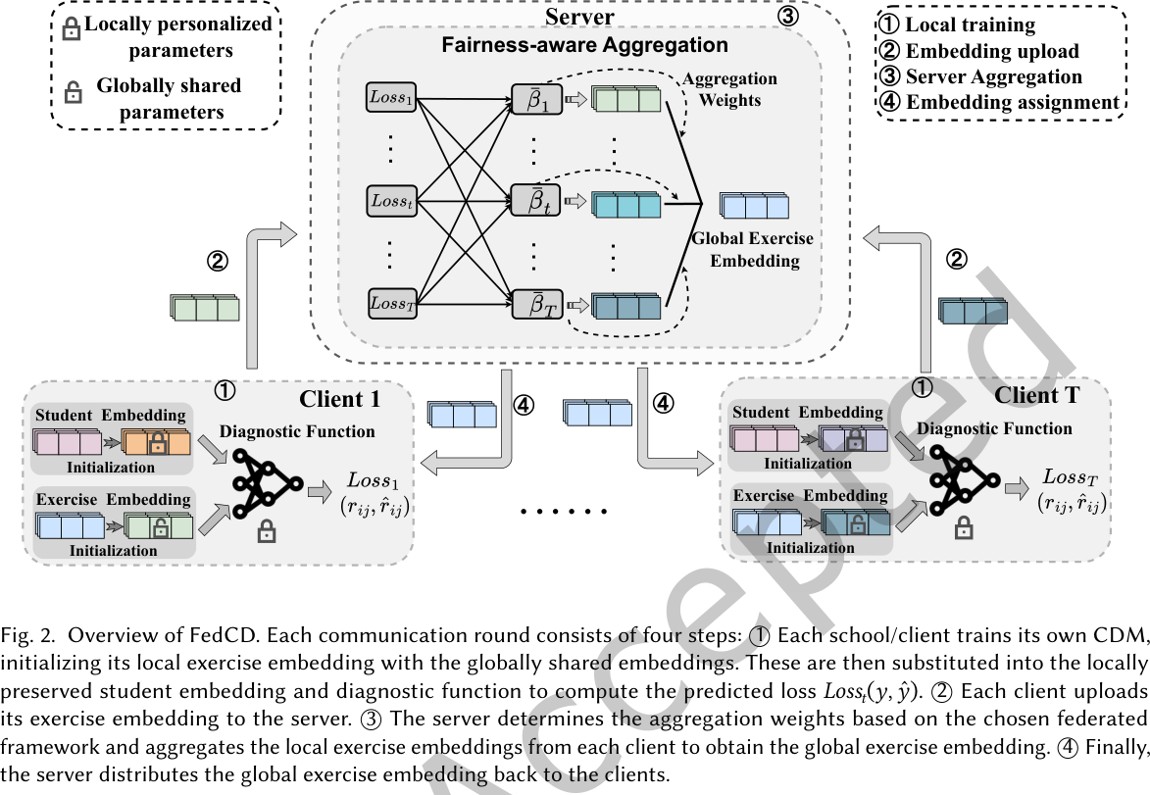
Each communication round consists of four steps: ① each school/client trains its own CD model, initializing its local exercise embedding with the globally shared embeddings, and computes the predicted loss on local students; ② each client uploads only its exercise embedding to the central server; ③ the server determines aggregation weights in a fairness-aware manner (loss-based weighting) and aggregates the local exercise embeddings into a global exercise embedding; ④ the server distributes the global exercise embedding back to all clients, while student embeddings and the diagnostic function never leave the client.
Experimental Results
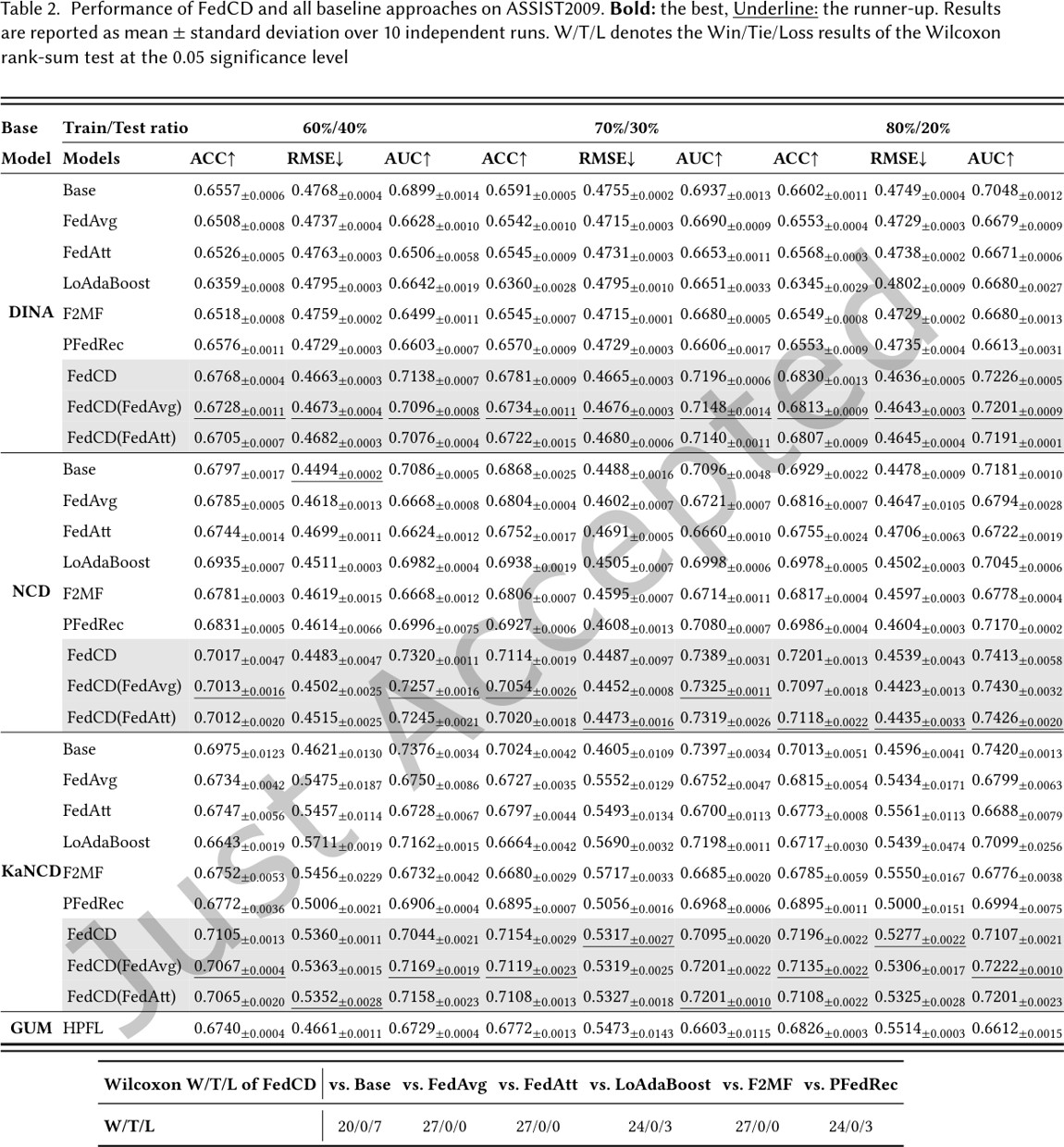
Compared algorithms: Five federated learning approaches — FedAvg, FedAtt, LoAdaBoost, F2MF, and PFedRec — under three base CD models (DINA, NCD, and KaNCD), plus GUM with HPFL.
Datasets: Three real-world datasets — ASSIST2009, ASSIST2012, and SLP-Math — under 60%/40%, 70%/30%, and 80%/20% train/test ratios.
Metrics: Diagnosis ACC, RMSE, and AUC, together with group fairness (GF) and degree of agreement (DOA) for fairness evaluation.
Overall results: FedCD achieves the best ACC/RMSE/AUC in most settings (e.g., it wins 27 out of 30 comparisons against FedAvg on ASSIST2009), and substantially reduces the performance disparity across schools with different data qualities, confirming both the diagnosis precision and the client fairness of the framework.
BibTeX
@article{yang2026fedcd, title = {FedCD: A Fairness-aware Federated Cognitive Diagnosis Framework}, author = {Yang, Shangshang and Han, Jialin and Yu, Xiaoshan and Wang, Ziwen and Jiang, Hao and Ma*, Haiping and Zhang, Xingyi and Min, Geyong}, journal = {ACM Transactions on Information Systems}, year = {2026}, doi = {10.1145/3860629} }