An Evolutionary Multi-Objective Neural Architecture Search Approach to Advancing Cognitive Diagnosis in Intelligent Education
IEEE Transactions on Evolutionary Computation, 2024
TEVC 2024
Abstract
As a pivotal technique in intelligent education systems, cognitive diagnosis (CD) serves to reveal students’ knowledge proficiency for better tackling subsequent tasks. Unfortunately, due to pursuing high model interpretability, existing manually designed models for CD often hold simplistic architectures, which cannot cope with intricate data in modern education platforms. Furthermore, the bias of human design limits the emergence of novel and effective CD models (CDMs). To develop interpretable and more effective models, thus this article proposes an evolutionary multiobjective neural architecture search (NAS) approach for CD. Specifically, we first adopt a comprehensive search space for the NAS task of CD: all candidate models can be encompassed by a general model that deals with three distinct types of inputs. Then, an innovative model interpretability objective is devised to formulate the architecture search task as a bi-objective optimization problem (BOP). To solve the BOP, we employ a multiobjective genetic programming (MOGP) as the search strategy to explore the search space. To make the employed MOGP search well, all architectures are first encoded by trees for easy optimization, and we devise a genetic operation and a population initialization strategy to expedite its convergence. Finally, the proposed approach is actually an MOGP-based NAS approach for CD. Extensive experiments show that CDMs searched by the proposed approach exhibit significantly better performance than existing models and hold as good interpretability as handcrafted models. Besides, the effectiveness of the proposed MOGP search strategy, the devised objective, and tailored strategies are validated.
Contributions
- Adopts a comprehensive search space for CD in which all candidate models are encompassed by a general model handling three distinct input types.
- Devises an innovative model interpretability objective to formulate CD-NAS as a multi-objective problem.
- Searches interpretable and more effective CD models automatically, freeing design from human bias.
Method
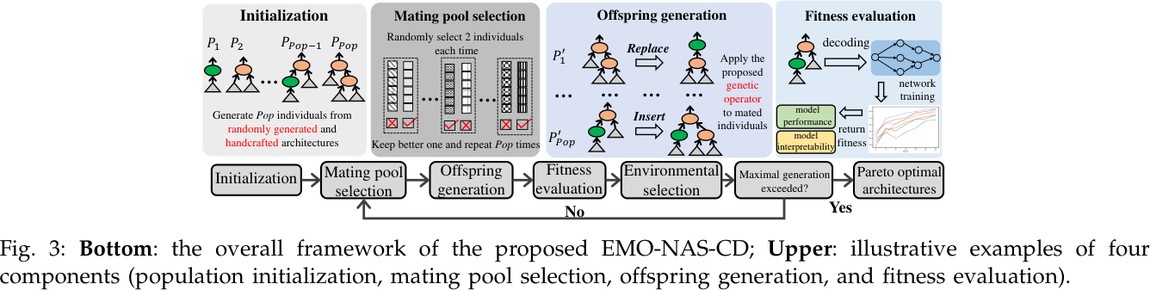
The search space is defined over a general cognitive diagnosis model that accepts three types of inputs; a multi-objective evolutionary algorithm jointly optimizes diagnosis accuracy and model interpretability, returning a Pareto set of architectures from which practitioners can choose.
Experimental Results
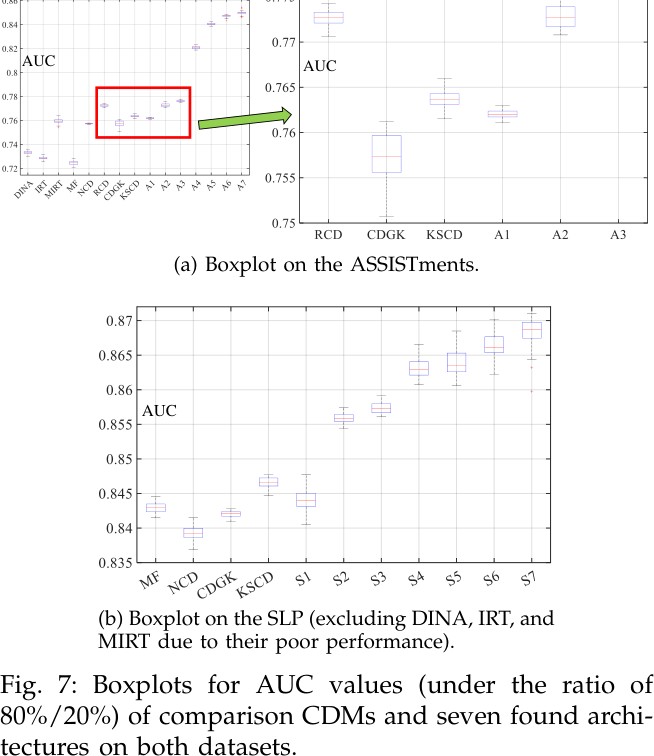
Compared algorithms: Representative manually-designed cognitive diagnosis models.
Datasets: Multiple real-world educational datasets.
Metrics: Diagnosis accuracy and model interpretability.
Overall results: The evolved CDMs outperform the manual designs while offering explicit interpretability, showing that automated multi-objective search yields models better suited to intricate modern educational data.
BibTeX
@article{yang2024emonascd, title = {An Evolutionary Multi-Objective Neural Architecture Search Approach to Advancing Cognitive Diagnosis in Intelligent Education}, author = {Yang, Shangshang and Ma, Haiping and Bi, Ying and Tian, Ye and Zhang*, Limiao and Jin, Yaochu and Zhang*, Xingyi}, journal = {IEEE Transactions on Evolutionary Computation}, year = {2024}, }