DisenGCD: A Meta Multigraph-assisted Disentangled Graph Learning Framework for Cognitive Diagnosis
Advances in Neural Information Processing Systems 37 (NeurIPS), 2024
NeurIPS 2024
Abstract
Existing graph learning-based cognitive diagnosis (CD) methods have made relatively good results, but their student, exercise, and concept representations are learned and exchanged in an implicit unified graph, which makes the interaction-agnostic exercise and concept representations be learned poorly, failing to provide high robustness against noise in students' interactions. Besides, lower-order exercise latent representations obtained in shallow layers are not well explored when learning the student representation. To tackle the issues, this paper suggests a meta multigraph-assisted disentangled graph learning framework for CD (DisenGCD), which learns three types of representations on three disentangled graphs: student-exercise-concept interaction, exercise-concept relation, and concept dependency graphs, respectively. Specifically, the latter two graphs are first disentangled from the interaction graph. Then, the student representation is learned from the interaction graph by a devised meta multigraph learning module; multiple learnable propagation paths in this module enable current student latent representation to access lower-order exercise latent representations, which can lead to more effective nad robust student representations learned; the exercise and concept representations are learned on the relation and dependency graphs by graph attention modules. Finally, a novel diagnostic function is devised to handle three disentangled representations for prediction. Experiments show better performance and robustness of DisenGCD than state-of-the-art CD methods and demonstrate the effectiveness of the disentangled learning framework and meta multigraph module. The source code is available at https://github.com/BIMK/Intelligent-Education/tree/main/DisenGCD.
Contributions
- Proposes DisenGCD, which learns student, exercise, and concept representations on three disentangled graphs instead of one implicit unified graph.
- Introduces a meta multigraph-assisted learning mechanism that disentangles the exercise–concept relation graph and concept dependency graph from the interaction graph.
- Substantially improves robustness against noise in student interactions.
Method
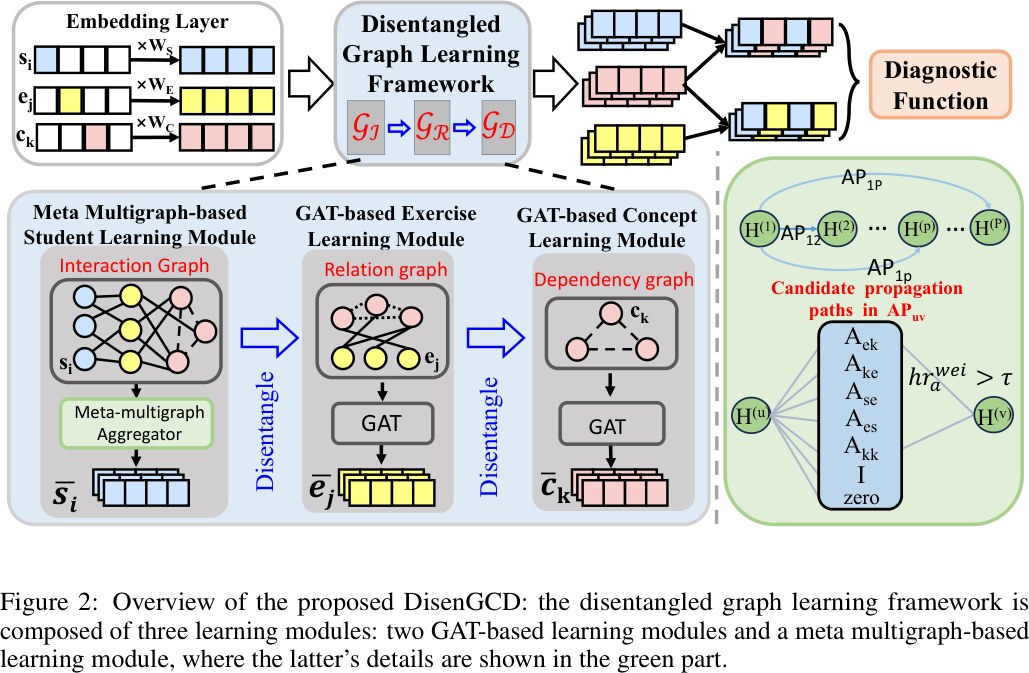
DisenGCD first separates the interaction graph into three task-specific graphs, learns representations on each with dedicated graph neural networks, and uses a meta-learning scheme to fuse the exercise/concept representations into the student representation, so that lower-order information is fully exploited and noise in interactions is filtered out.
Experimental Results
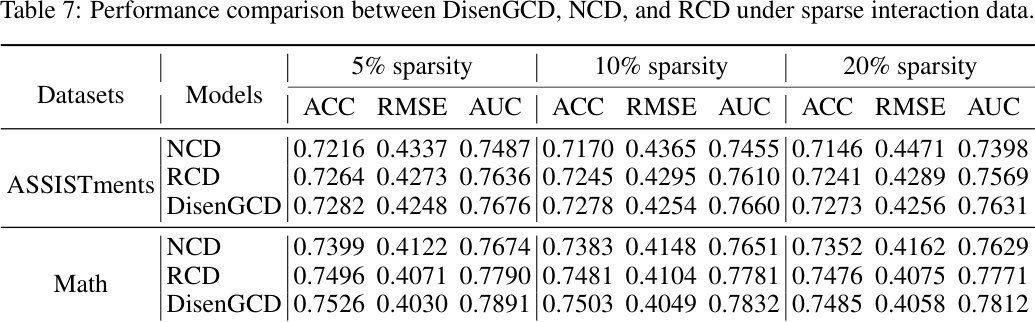
Compared algorithms: Five CDMs: DINA, MIRT, NCD, ECD, and RCD.
Datasets: ASSISTments and Math under four data-splitting ratios (40/10/50 – 70/10/20).
Metrics: ACC, RMSE, and AUC.
Overall results: DisenGCD is the best in every column on both datasets; it also degrades far more slowly than RCD as interaction noise grows.
BibTeX
@inproceedings{yang2024disengcd, title = {DisenGCD: A Meta Multigraph-assisted Disentangled Graph Learning Framework for Cognitive Diagnosis}, author = {Yang, Shangshang and Chen, Mingyang and Wang, Ziwen and Yu, Xiaoshan and Zhang, Panpan and Ma*, Haiping and Zhang, Xingyi}, booktitle = {Advances in Neural Information Processing Systems 37 (NeurIPS)}, year = {2024}, }