Breaking Robustness Barriers in Cognitive Diagnosis: A One-Shot Neural Architecture Search Perspective
ACM SIGKDD Conference on Knowledge Discovery and Data Mining (KDD), 2026
KDD 2026
Abstract
With the advancement of network technologies, intelligent tutor- ing systems (ITS) have emerged to deliver increasingly precise and tailored personalized learning services. Cognitive diagnosis (CD) has emerged as a core research task in ITS, aiming to infer learn- ers’ mastery of specific knowledge concepts by modeling the map- ping between learning behavior data and knowledge states. How- ever, existing research prioritizes model performance enhancement while neglecting the pervasive noise contamination in observed response data, significantly hindering practical deployment. Fur- thermore, current cognitive diagnosis models (CDMs) rely heav- ily on researchers’ domain expertise for structural design, which fails to exhaustively explore architectural possibilities, thus leav- ing model architectures’ full potential untapped. To address this issue, we propose OSCD, an evolutionary multi-objective One- Shot neural architecture search method for Cognitive Diagnosis, designed to efficiently and robustly improve the model’s capabil- ity in assessing learner proficiency. Specifically, OSCD operates through two distinct stages: training and searching. During the training stage, we construct a search space encompassing diverse architectural combinations and train a weight-sharing supernet ∗Corresponding author. This work is licensed under a Creative Commons Attribution 4.0 International License. KDD ’26, Jeju Island, Republic of Korea © 2026 Copyright held by the owner/author(s). ACM ISBN 979-8-4007-2258-5/2026/08 https://doi.org/10.1145/3770854.3780159 represented via the complete binary tree topology, enabling com- prehensive exploration of potential architectures beyond manual design priors. In the searching stage, we formulate the optimal architecture search under heterogeneous noise scenarios as a multi- objective optimization problem (MOP), and develop an optimization framework integrating a Pareto-optimal solution search strategy with cross-scenario performance evaluation for resolution. Exten- sive experiments on real-world educational datasets validate the effectiveness and robustness of the optimal architectures discovered by our OSCD model for CD tasks.
Contributions
- Identifies two long-neglected issues in cognitive diagnosis: pervasive noise contamination in observed response data, and the reliance of existing CDM architectures on manual expert design.
- Proposes OSCD, an evolutionary multi-objective one-shot neural architecture search framework that automatically designs noise-robust cognitive diagnosis models.
- Achieves a much better robustness–accuracy trade-off than handcrafted CDMs at a fraction of the search cost thanks to the one-shot paradigm.
Method
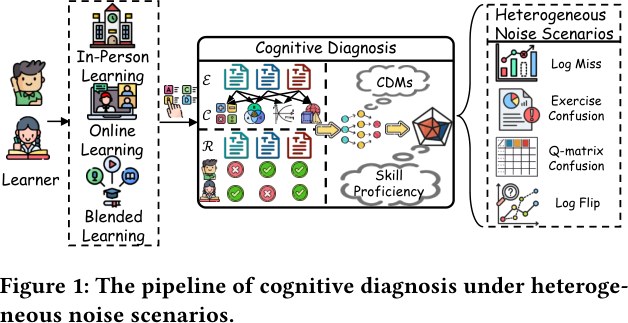
OSCD trains a weight-sharing supernet of cognitive diagnosis models once, and then applies an evolutionary multi-objective search over the supernet to discover architectures that jointly optimize diagnosis accuracy and robustness against noisy response data.
Experimental Results
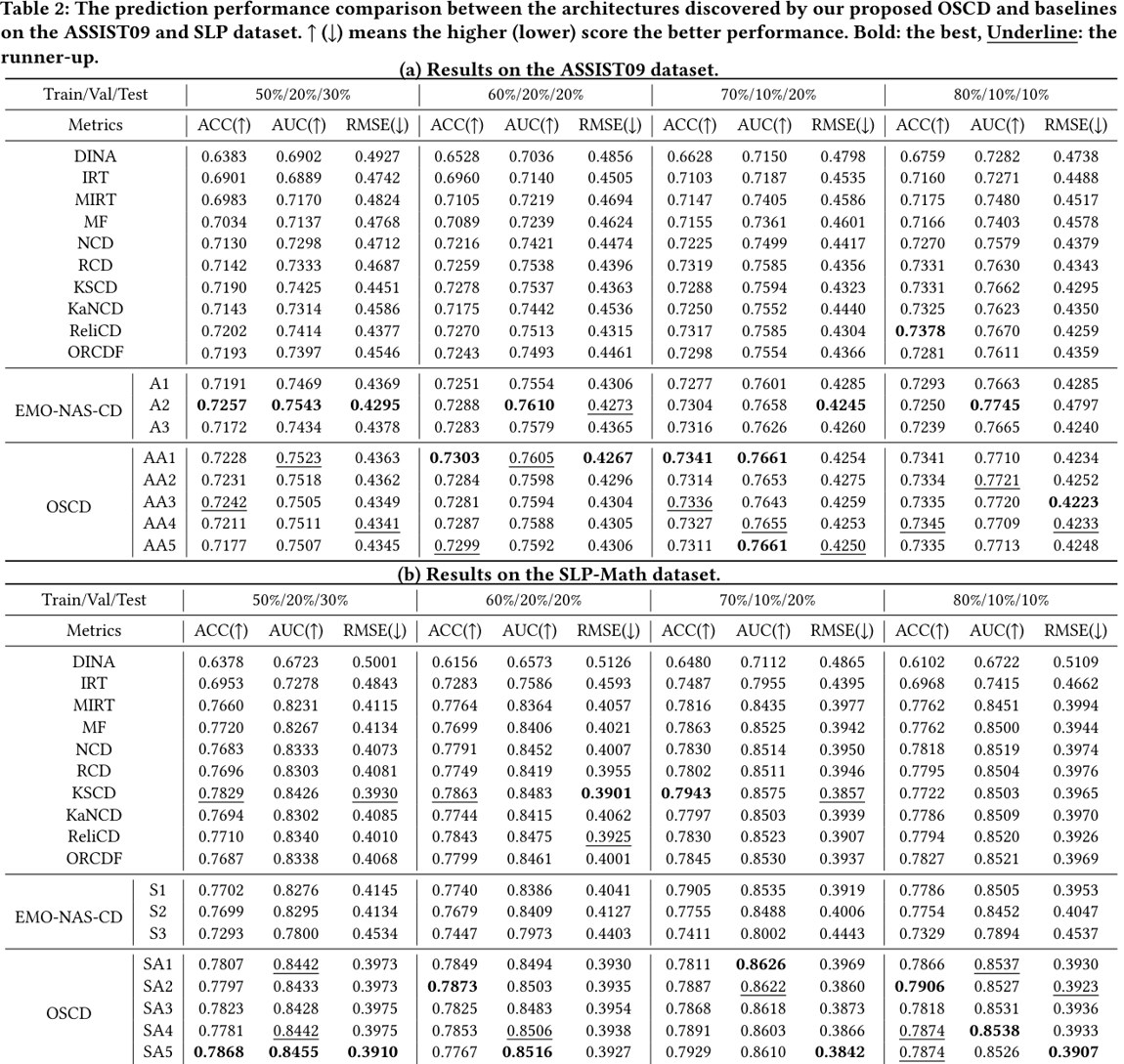
Compared algorithms: Ten handcrafted CDMs (DINA, IRT, MIRT, MF, NCD, RCD, KSCD, KaNCD, ReCD, ORCDF) and the EMO-NAS-CD search baseline.
Datasets: ASSIST09 and SLP-Math under four train/val/test splits (50/20/30 – 80/10/10).
Metrics: ACC, AUC, and RMSE.
Overall results: The architectures found by OSCD rank first on nearly every split and shrink the least as training data decreases; on SLP-Math OSCD variants take the best ACC/AUC in all four settings.
BibTeX
@inproceedings{wang2026breaking, title = {Breaking Robustness Barriers in Cognitive Diagnosis: A One-Shot Neural Architecture Search Perspective}, author = {Wang, Ziwen and Yang*, Shangshang and Yu, Xiaoshan and Ma, Haiping and Zhang, Xingyi}, booktitle = {ACM SIGKDD Conference on Knowledge Discovery and Data Mining (KDD)}, year = {2026}, doi = {10.1145/3770854.3780159} }