Beyond Item Selection: Rethinking Ability Evolution in Computerized Adaptive Testing
Abstract
Contributions
- Reveals that the granularity of ability update mechanisms (step-based vs. batch-based) has a substantial impact on ability estimation accuracy in CAT.
- Systematically analyzes the evolutionary dynamics of examinee abilities throughout the adaptive testing process.
- Provides practical guidelines for selecting update mechanisms in real-world CAT deployments.
Method
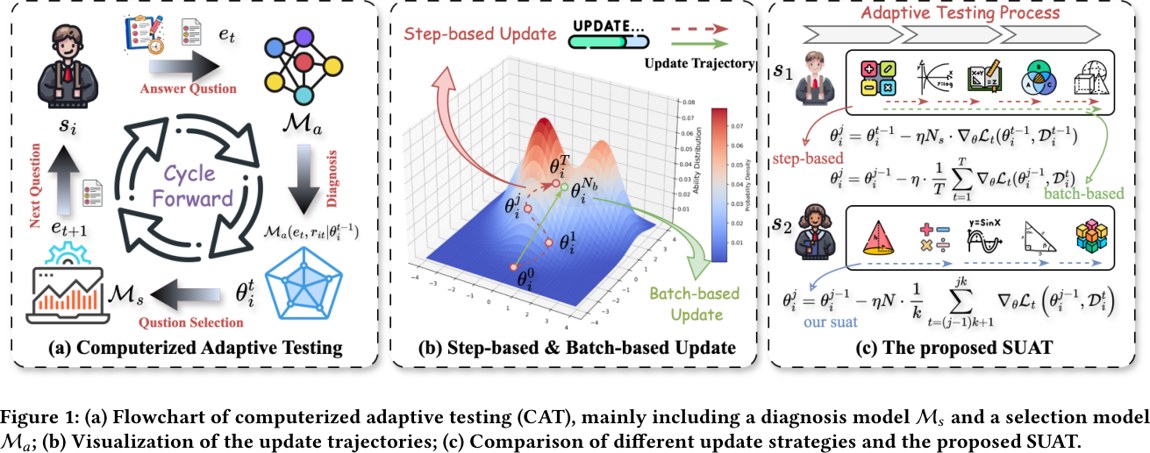
The paper models ability estimation as a continuously evolving process during adaptive testing, and compares update mechanisms of varying granularity — updating the ability estimate after each answered item (step-based) versus after a batch of items (batch-based) — analyzing how each strategy affects the convergence and precision of ability estimation.
Experimental Results
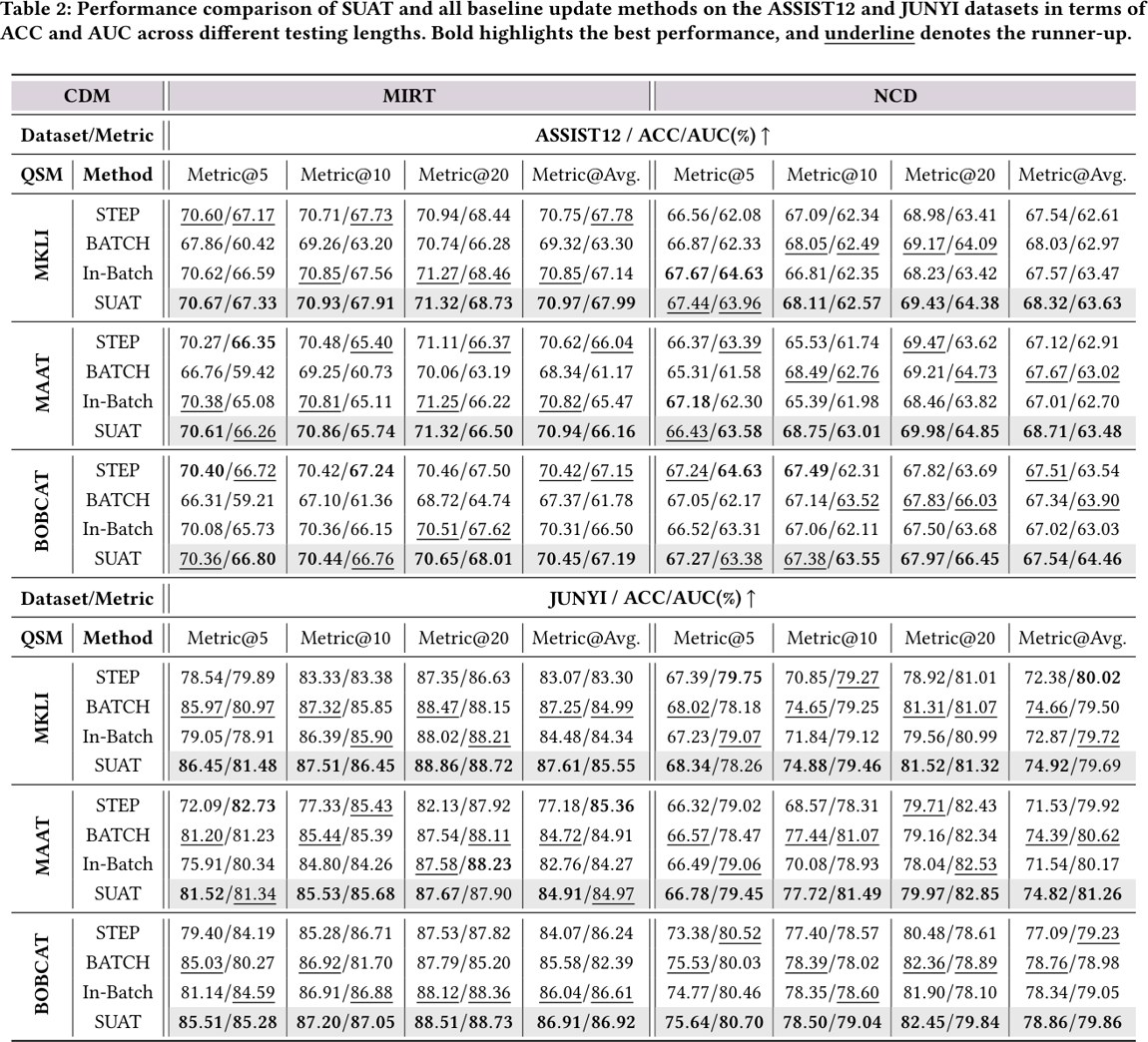
Compared algorithms: Three representative update strategies — MKLI, MAAT, and BOCAT — each instantiated with STEP, BATCH, and In-Batch updating variants, combined with three question selection models (QSM).
Datasets: ASSIST12 and JUNYI.
Metrics: ACC and AUC at testing lengths of 5/10/20 questions plus the average.
Overall results: SUAT achieves the best ACC/AUC in almost all CDM–strategy–length combinations (e.g., 84.61/85.55 average ACC on JUNYI under MAAT), showing that finer-grained ability updating translates directly into more precise adaptive testing.
BibTeX
@inproceedings{yu2026beyond, title = {Beyond Item Selection: Rethinking Ability Evolution in Computerized Adaptive Testing}, author = {Yu, Xiaoshan and Li, Jing and Yang*, Shangshang and Wang, Ziwen and Ma, Haiping and Zhang, Xingyi}, booktitle = {ACM SIGKDD Conference on Knowledge Discovery and Data Mining (KDD)}, year = {2026}, doi = {10.1145/3770855.3817615} }